

IndustryChris ThomsonThu 23 Jul 26
Developers Urged to Embrace Brutal Honesty in the Age of Change

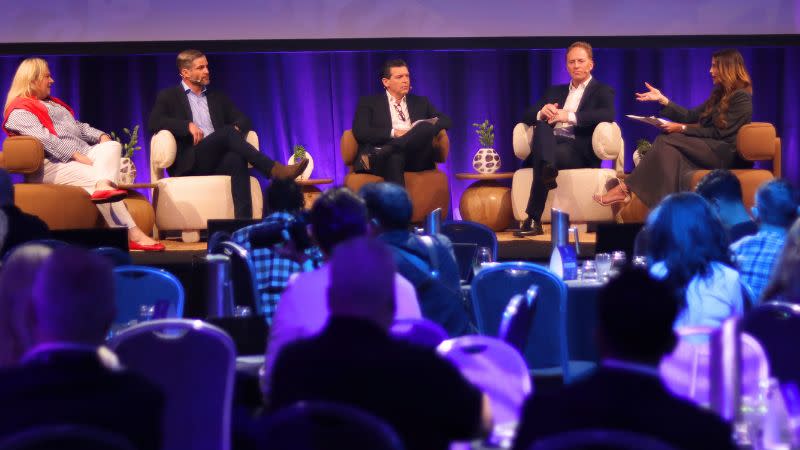
Australian developers have been buffeted by a tsunami of change and challenge that members of the opening panel session of The Urban Developer’s flagship Urbanity-26 on the Gold Coast are navigating and happy to talk about.
At the outset of the session, JLL Australian head of residential project sales Freya Watson sets the scene.
“We’ve seen a whole swathe of changes in the past six to 12 months from government policy about taxation,” she says.
“We’ve had Trump and Iran ... changes to CGT and self-managed super funds property ... but that always brings opportunities and there’s always developments that still prosper in times of uncertainty.”
She says that when home-buyers face uncertainty, there is “a flight to quality” that suits “developers who are sitting in that space”.
“The biggest piece of advice [for developers], I would say, is to demand brutal honesty, firstly from yourself, from your staff definitely, but also from your advisors,” she says.
“In the age of change, [being] brutally honest is the way to go.”
Flight to quality
She says that when buyers face uncertainty, there is “a flight to quality” that suits “developers who are sitting in that space”.
One example is sustainability, with which Watson says the industry is yet to come to grips.
“Were still really seeing that as a cost rather than as a benefit,” she says.
“Pre-Covid, across Asia, the younger generation of property buyers who are now coming into their absolute buying power were talking about sustainability ... cost benefits from having more efficient and effective energy systems in their apartments.
“It sort of fell off the radar, but I’ve got no doubt there is some sort of premium that will come from green living eventually.
“It will be essential for us to market in the right way and it will need to be truly something that benefits people.”
Resilient cities attract talent
Broadening the discussion, Urbis chief executive Ben Pollack says the problems facing developers are related not just to planning but span design and economics design problem, an economics to what he calls “integrated problems”.
“What we’re seeing in response [to the liveability challenge] is a real shift towards precincts, place capital [and] quality amenity, because livability, when it’s focussed on, creates value [and contributes to health and wellbeing,” he says.
“It builds resilience in cities that attracts talent, which ultimately brings with it an investability and capital into those markets.”
For Gurner Group chief development officer Robert Clarke, the focus is not on liveability so much as longevity.
“What’s informing that theme is the ageing population, a burgeoning immigrant population moving into Australia, and also looking at how we have a point of difference,” he says.
“And I guess it’s the attention to detail that we’re able to put into every aspect of a project and how we put it together.
“What I’m talking about is there’s different aspirations for younger people ... a big focus on health and wellness [and] for elderly people they don’t just want to live longer, they actually want to live longer better.”
Blind spot in the side mirrors
Clarke says a blind spot in the development sector’s side mirrors is the “huge growth in the private credit market”.
“It’s a quarter-of-a-trillion-dollar market now that’s stepped in to fill the void of the major banks in terms of funding development,” he says.
“It’s an unregulated market, so it will be interesting to see what plays out with private credit now stepping into projects and becoming developers where they’ve had problems.
![Urbis chief executive Ben Pollack says the problems facing developers are related not just to planning but span design and economics design problem, an economics to what he calls “integrated problems”.
“What we’re seeing in response [to the liveability challenge] is a real shift towards precincts, place capital [and] quality amenity, because livability, when it’s focussed on, creates value [and contributes to health and wellbeing,” he says.
“It builds resilience in cities that attracts talent, which ultimately brings with it an investability and capital into those markets.”](https://images.ctfassets.net/8pr762qjocl3/DBm7gCarO0Xovz7oVKoin/fcb845aeb456ff0e12fd8a26fd149c86/IMG_2777.jpg?w=1500)
“That wasn’t their objective to do that; I think that’s something we will need to be aware of.”
Turning to a question on everybody’s lips, Mosaic Property Group managing director Brook Monahan shares his aspirations for the impact of artificial intelligence.
“What I hope will happen over time is that you’ll get this diminishing information assymetry, where everybody should be able to more accurately assess opportunities,” he says.
“And [insights into] how do we integrate planning solutions with construction methodology and different markets through a system that can give us real-time feedback around adjustments to design principles to meet the product type the market can afford to pay but can still get a risk-adjusted return so their capital can flow through those projects and scale up.
“I think what AI will create is the ability for the entire market to have access to real-time information a lot quicker to make more accurate and better decisions and so hopefully there's not only less development failure, but more allocation of capital for projects that are actually going to work.”
Human-machine approach
Pollack says AI will “change productivity, but we’ve still got to get skilled minds into our sector”.
“We see it as a massive opportunity [but] the danger of relying too much on AI is you get a homogenisation of outcomes [and] ideas start to become the same,” he says.
“We’re certainly taking a human-machine approach, but ultimately we can’t insure against a machine, we can inure against a human.
“We can’t lose sight of the fact of the things that make us human; our point of difference ... is that human judgement, that creativity, the ability to see patterns in what we do that I think we all need to remain focused on.”





